
You are using an out of date browser. It may not display this or other websites correctly.
You should upgrade or use an alternative browser.
You should upgrade or use an alternative browser.
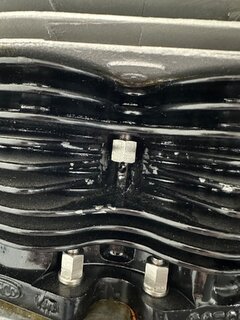
How in the world do you tighten this.
- Thread starter Jwvert
- Start date


- Joined
- Nov 2004
- Messages
- 21,419


concours
FULL MEMBER
- Joined
- Dec 2011
- Messages
- 10,642

Take a box end wrench and use a grinder to thin the boxI have tried everything I own. Used forceps to get it that far.


grandpaul
FULL MEMBER
- Joined
- Jan 2008
- Messages
- 14,099
Thin wall, box end, spanner. I've got 2 of them because I ground one down then lost it. It was a forgone conclusion that I'd find it as soon as I made a 2nd one!I have tried everything I own. Used forceps to get it that far.

grandpaul
FULL MEMBER
- Joined
- Jan 2008
- Messages
- 14,099
Not a terrible idea.I ground a little metal off the barrels so the spanner would fit.
The first wrench that I ground down, split open. I had to grind a second one, a tiny bit at a time, till it JUST fit. That one never failed me.

marshg246
FULL MEMBER
- Joined
- Jul 2015
- Messages
- 6,077
I agree that it is not required, but it is quite helpful. Also, on some barrels, even it needs to be ground some.Not absolutely necessary.

Schwany
FULL MEMBER
- Joined
- Apr 2020
- Messages
- 3,858
Before installing 3/8-16 inserts in the head for the 3 studs I used one of these for the Brit nuts and studs. 3/16 W on the small end and 1/4 W on the big end. Made in Germany. Probably not anymore though. I did have to grind a little bit off the casting around the big end. I still use it once in a while since it does fit the Triumph exhaust clamps I use, and a couple of other things on the head.


hybridracer
MEMBER
- Joined
- Feb 2013
- Messages
- 376
Important note for the non-engineers reading this :Cut the "c" end off a spanner, leaving the ring end, thin the ring if necessary with a grinder. Weld a piece of 1'2" square bar and you can (should!) use your torque wrench.
The maximum torque applied to the nut using robs method is only the same as the torque setting on the torque wrench when the torque wrench is at 90 degrees to the spanner shaft. For any other angle please do not use this method unless you are confident in your ability to set the corrected torque on the torque wrench for that angle, torque wrench and spanner lengths.
grandpaul
FULL MEMBER
- Joined
- Jan 2008
- Messages
- 14,099
Reminds me of my oldest brother, when I helped him overhaul a VW bus engine. He was using the "Whole Earth Guide to the VW", and it got to the point where we needed to torque the flywheel bolts.Important note for the non-engineers reading this :
The maximum torque applied to the nut using robs method is only the same as the torque setting on the torque wrench when the torque wrench is at 90 degrees to the spanner shaft. For any other angle please do not use this method unless you are confident in your ability to set the corrected torque on the torque wrench for that angle, torque wrench and spanner lengths.
He whipped out his slide rule, measuring tape, and felt-tip marker, got a piece of electrical conduit about 5 feet long, a gallon jug of water, and a piece of string. He did some calculations based on the torque value, measured and marked a few places on the pipe, drilled a hole on one of the marks, tied the string through it and tied the other end of the string to the handle on the jug of water. Next, he slipped the ratchet handle into the other end of the pipe. I carefully held the gallon jug (hanging under the far end of the pipe) with the string almost tight while he placed the socket on the first flywheel bolt, with the pipe sticking out horizontally. When he gave me the signal, I slowly released the gallon jug until it stopped on it's own. We repeated that with all of the bolts, and called it a day.
The next day, a friend of his showed up with a torque wrench and they checked all the bolts. EVERY ONE was perfectly torqued!
(crude drawing, you get the idea)
Last edited:
hybridracer
MEMBER
- Joined
- Feb 2013
- Messages
- 376
Love it! Much of my working life was spent doing calculations.Reminds me of my oldest brother, when I helped him overhaul a VW bus engine. He was using the "Whole Earth Guide to the VW", and it got to the point where we needed to torque the flywheel bolts.
He whipped out his slide rule, measuring tape, and felt-tip marker, got a piece of electrical conduit about 5 feet long, a gallon jug of water, and a piece of string. He did some calculations based on the torque value, measured and marked a few places on the pipe, drilled a hole on one of the marks, tied the string through it and tied the other end of the string to the handle on the jug of water. Next, he slipped the ratchet handle into the other end of the pipe. I carefully held the gallon jug (hanging under the far end of the pipe) with the string almost tight while he placed the socket on the first flywheel bolt, with the pipe sticking out horizontally. When he gave me the signal, I slowly released the gallon jug until it stopped on it's own. We repeated that with all of the bolts, and called it a day.
The next day, a friend of his showed up with a torque wrench and they checked all the bolts. EVERY ONE was perfectly torqued!
(crude drawing, you get the idea)
View attachment 123523

Saber
FULL MEMBER
- Joined
- Mar 2019
- Messages
- 556
Looks like a whiskey jug to me.Reminds me of my oldest brother, when I helped him overhaul a VW bus engine. He was using the "Whole Earth Guide to the VW", and it got to the point where we needed to torque the flywheel bolts.
He whipped out his slide rule, measuring tape, and felt-tip marker, got a piece of electrical conduit about 5 feet long, a gallon jug of water, and a piece of string. He did some calculations based on the torque value, measured and marked a few places on the pipe, drilled a hole on one of the marks, tied the string through it and tied the other end of the string to the handle on the jug of water. Next, he slipped the ratchet handle into the other end of the pipe. I carefully held the gallon jug (hanging under the far end of the pipe) with the string almost tight while he placed the socket on the first flywheel bolt, with the pipe sticking out horizontally. When he gave me the signal, I slowly released the gallon jug until it stopped on it's own. We repeated that with all of the bolts, and called it a day.
The next day, a friend of his showed up with a torque wrench and they checked all the bolts. EVERY ONE was perfectly torqued!
(crude drawing, you get the idea)
View attachment 123523
grandpaul
FULL MEMBER
- Joined
- Jan 2008
- Messages
- 14,099
NO WAY! That would have thrown off the calculations!Looks like a whiskey jug to me.
...besides, we don't use no JUGS! We each have our own tin cup at the still...
(crude drawing, you get the idea)
Left handed threads??
grandpaul
FULL MEMBER
- Joined
- Jan 2008
- Messages
- 14,099
Reminds me of my oldest brother, when I helped him overhaul a VW bus engine. He was using the "Whole Earth Guide to the VW", and it got to the point where we needed to torque the flywheel bolts.
He whipped out his slide rule, measuring tape, and felt-tip marker, got a piece of electrical conduit about 5 feet long, a gallon jug of water, and a piece of string. He did some calculations based on the torque value, measured and marked a few places on the pipe, drilled a hole on one of the marks, tied the string through it and tied the other end of the string to the handle on the jug of water. Next, he slipped the ratchet handle into the other end of the pipe. I carefully held the gallon jug (hanging under the far end of the pipe) with the string almost tight while he placed the socket on the first flywheel bolt, with the pipe sticking out horizontally. When he gave me the signal, I slowly released the gallon jug until it stopped on it's own. We repeated that with all of the bolts, and called it a day.
The next day, a friend of his showed up with a torque wrench and they checked all the bolts. EVERY ONE was perfectly torqued!
(crude drawing, you get the idea)
View attachment 123523
Isn't it the case that if you have a good engine, you can change the van in a couple of hours?
Similar threads

- Replies
- 0
- Views
- 124
- Replies
- 11
- Views
- 635

- Replies
- 7
- Views
- 916


- Replies
- 11
- Views
- 1,085


- Replies
- 11
- Views
- 1,847