
You are using an out of date browser. It may not display this or other websites correctly.
You should upgrade or use an alternative browser.
You should upgrade or use an alternative browser.
MK III starter cable upgrade size, what are you all using?
- Thread starter concours
- Start date

- Joined
- Jan 2, 2013
- Messages
- 4,235

When it comes to battery cables, I use the largest gauge I can get or fit. Same goes for the batteries in my 4 wheelers.
Slick
Slick

- Joined
- Jan 14, 2004
- Messages
- 2,716
I don't have a Mk3 but, DD lists #6's on his website.
I saw the three wires, didn't realize they had a solenoid.
So I went here..

 granttiller.com
Which leads to more questions.
If I'm seeing this correctly, the solenoid fires off with completion of the ground, which also gives a full voltage
charge to the coils, by passing the ballast resistor.
Is this correct?
Not trying to high jack, just curious..
Back to the cables. Bigger cables are obviously better, electrically.
I usually go with bigger is better in everything.
Now I'm back to using the correct size, not oversize.
It would seem the #6's would be easier to work with in tight spaces, than #4's.
Just my $.02.
I saw the three wires, didn't realize they had a solenoid.
So I went here..
Grant Tiller | ***UPDATED*** Norton Commando Wiring Diagrams
Updated Norton Commando wiring diagrams with improved resolution and expert feedback. Get accurate electrical schematics for your classic motorcycle restoration project.
granttiller.com
Which leads to more questions.
If I'm seeing this correctly, the solenoid fires off with completion of the ground, which also gives a full voltage
charge to the coils, by passing the ballast resistor.
Is this correct?
Not trying to high jack, just curious..
Back to the cables. Bigger cables are obviously better, electrically.
I usually go with bigger is better in everything.
Now I'm back to using the correct size, not oversize.
It would seem the #6's would be easier to work with in tight spaces, than #4's.
Just my $.02.

- Joined
- Nov 20, 2004
- Messages
- 21,331

If I'm seeing this correctly, the solenoid fires off with completion of the ground,
Yes.
which also gives a full voltage
charge to the coils, by passing the ballast resistor.
Is this correct?
But is only used with the original points ignition, not electronic.
Last edited:

concours
VIP MEMBER
- Joined
- Dec 29, 2011
- Messages
- 10,548
Thank you for posting that DD link.I don't have a Mk3 but, DD lists #6's on his website.
I saw the three wires, didn't realize they had a solenoid.
So I went here..
Grant Tiller | ***UPDATED*** Norton Commando Wiring Diagrams
Updated Norton Commando wiring diagrams with improved resolution and expert feedback. Get accurate electrical schematics for your classic motorcycle restoration project.
Which leads to more questions.
If I'm seeing this correctly, the solenoid fires off with completion of the ground, which also gives a full voltage
charge to the coils, by passing the ballast resistor.
Is this correct?
Not trying to high jack, just curious..
Back to the cables. Bigger cables are obviously better, electrically.
I usually go with bigger is better in everything.
Now I'm back to using the correct size, not oversize.
It would seem the #6's would be easier to work with in tight spaces, than #4's.
Just my $.02.

Britbike850
VIP MEMBER
- Joined
- Dec 9, 2012
- Messages
- 99
I use #4 welding cable… very flexible
Rod
Rod
concours
VIP MEMBER
- Joined
- Dec 29, 2011
- Messages
- 10,548
...like angel hair.I use #4 welding cable… very flexible
Rod


Deets55
VIP MEMBER
- Joined
- Oct 3, 2013
- Messages
- 1,685
# 6 Marine, crimped and soldered ends.#6?
#4?
I also connect all the main wire feeds (ie Brown/blue) off the solenoid lug to avoid clutter at the battery
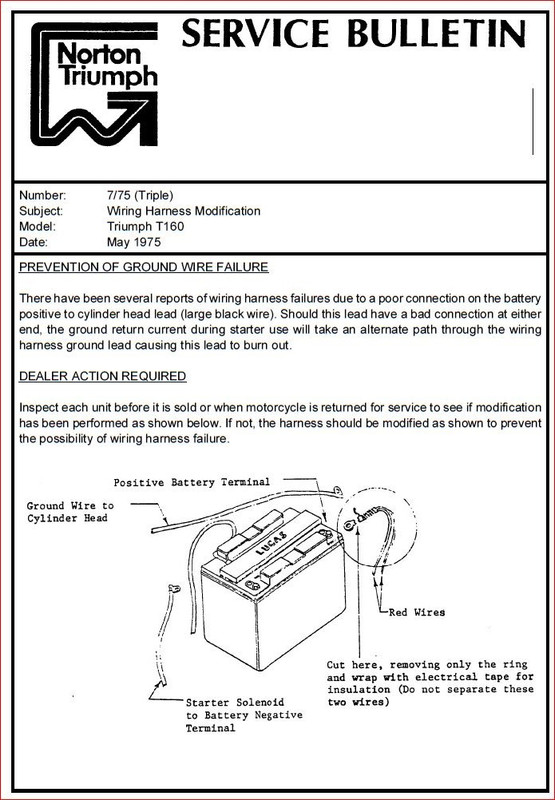
There is also a service bulletin saying to remove the small gauge ground wires from the motor (by the head steady) and rely on the big ground behind the barrels.
Pete
ilikevelos
VIP MEMBER
- Joined
- Jul 7, 2009
- Messages
- 252
I don't have a mk3 but I like #4 for starter power cable on any big single or twin. Less voltage drop.

- Joined
- Nov 20, 2004
- Messages
- 21,331
There is also a service bulletin saying to remove the small gauge ground wires from the motor (by the head steady) and rely on the big ground behind the barrels.
There was an NVT Service Bulletin about disconnecting and clipping off the battery positive terminal from the harness to prevent it potentially burning out from starter motor current. This also applies to the 850 Mk3 in which case the harness head steady (to engine) wire should not be removed.
- Joined
- Nov 20, 2004
- Messages
- 21,331
Why does it say Large Black wire?
That's T160. For the 850 Mk3 disconnect the harness red from the battery terminal if fitted.

- Joined
- Dec 28, 2009
- Messages
- 5,627

Don't know the gauge of the starter wire on my MK111 , but it's thick , big , yellow insulator coated , using gold plated larger terminal ends . I bought the gold plated ring terminal ends many years back when gold was cheap and the price was fixed , not floating . Works a treat .
concours
VIP MEMBER
- Joined
- Dec 29, 2011
- Messages
- 10,548
Thanks for the replies.
I made up the #6 fine strand (tinned) marine cables. I had done a similar upgrade on my Tiger 1050 a few years back. Buying the battery cable crimping anvil then, used it many times since. I had the #6 x 1/4" lugs on hand.

I made up the #6 fine strand (tinned) marine cables. I had done a similar upgrade on my Tiger 1050 a few years back. Buying the battery cable crimping anvil then, used it many times since. I had the #6 x 1/4" lugs on hand.
Britbike850
VIP MEMBER
- Joined
- Dec 9, 2012
- Messages
- 99
NiceThanks for the replies.
I made up the #6 fine strand (tinned) marine cables. I had done a similar upgrade on my Tiger 1050 a few years back. Buying the battery cable crimping anvil then, used it many times since. I had the #6 x 1/4" lugs on hand.
View attachment 115211
Similar threads

- Replies
- 24
- Views
- 2,928

- Replies
- 13
- Views
- 1,742

- Replies
- 14
- Views
- 5,535
