New CDO Top End Break-in

Riding "gently" whilst running in rings and bores is almost a guarantee of having to strip it again and hone the bores because they are glazed.
You need to load up the pressure in the cylinders to push the rings out against the bores
 
This break in procedure is interesting to me- I’ve always adhered to the “warm it up, shut er down and re torque / valve lash then ride it like you stole it to seat the rings” school of break in. What’s the advantage of slow/no load breakin? Every engine I’ve ever done is basically the opposite of this program, and they’ve all performed pretty well for a shade tree mechanics work. Not being a jerk, legit trying to learn from others 🙂
ABSOLUTELY you need to load the engine hard during break in.
Just make sure you do not:
A) overheat it
B) over rev it
C) lug (labour) it

Just accelerate it hard up through the gears, coast down with light throttle, repeat, repeat, repeat.... all you can for a couple hundred miles.

To your point, "slow/no load" is a great way to have less than optimum compression and excessive oil consumption.
The factory procedures only served their warranty interests. (IE; no seized engines)

This applies to any engine, not just commandos.
 
Last edited:
Do these composite head gaskets typically blow at the same area if and when they do?
When my original CP head gasket blew, it blew in a big way complete left hand side of the head/cylinder without any warning at all, spuing oil out everywhere on one side of the head gasket, it just decided to let go, lucky for me I wasn't far from home, pulling the head off the gasket had blown away big time on the left side, not at the front or back just on the left side, my mate Don who got me into Norton's just told me to replace it with a copper head gasket so I did, never used a CPH gasket ever again in over 47 years.
Never had a copper head gasket blow out like that, and if I do get a slight seepage just retorque the head usual stops it, but have only happened to me once where I had to retorque a copper head gasket from a seepage.

Ash
 
When my original CP head gasket blew, it blew in a big way complete left hand side of the head/cylinder without any warning at all, spuing oil out everywhere on one side of the head gasket, it just decided to let go, lucky for me I wasn't far from home, pulling the head off the gasket had blown away big time on the left side, not at the front or back just on the left side, my mate Don who got me into Norton's just told me to replace it with a copper head gasket so I did, never used a CPH gasket ever again in over 47 years.
Never had a copper head gasket blow out like that, and if I do get a slight seepage just retorque the head usual stops it, but have only happened to me once where I had to retorque a copper head gasket from a seepage.

Ash
Copper works the balls. 🏁💪🏻
 
I can't believe how many heat cycles some do retorquing a CP head gasket, with copper retorque once at 500 miles and forget for years, I like my Norton but I like it more when less work is involved, more riding time in my mind.

Over the years I have worked on 3 Commando's all with blown CP head gaskets and same thing each time the gaskets just blew out, never had a copper gasket let go like the CPH gaskets.
 
What do people on our side of the pond use to seal copper head gaskets?
The US favours Pliobond, but it does not seem to be available over here
Threebond 1207B, 1211, 1215, and 1217H are silicone based sealants all rated to 250C. Possible?
Threebond 1184 is my usual sealant rated to 150C Possible ? Borderline temperature but advantage of not being silicone, so less chance of bits clogging oilways
Has anyone measured the head temperature on a Commando?
 
What do people on our side of the pond use to seal copper head gaskets?
The US favours Pliobond, but it does not seem to be available over here
Threebond 1207B, 1211, 1215, and 1217H are silicone based sealants all rated to 250C. Possible?
Threebond 1184 is my usual sealant rated to 150C Possible ? Borderline temperature but advantage of not being silicone, so less chance of bits clogging oilways
Has anyone measured the head temperature on a Commando?
JS will send you Pliobond and thin copper wire to the UK.His copper head gaskets are also excellent and available in different thicknesses.

I’m not certain, but I think Pliobonds closest U.K. relative is Evostick. Never tried it though.

Around the pushrod tubes I’ve used Pliobond and I’ve also used Wellseal. Both seem to have worked, so take from that what you will!

Neither of my engines have the oil return hole.
 
What do people on our side of the pond use to seal copper head gaskets?
The US favours Pliobond, but it does not seem to be available over here
Threebond 1207B, 1211, 1215, and 1217H are silicone based sealants all rated to 250C. Possible?
Threebond 1184 is my usual sealant rated to 150C Possible ? Borderline temperature but advantage of not being silicone, so less chance of bits clogging oilways
Has anyone measured the head temperature on a Commando?
https://www.midland-mustangs.co.uk/shop/permatex-copper-spray-a-gasket-high-temp-sealant-12-oz no need for anything else
 
Thanks for a great thread because my head will soon go back on. This is the first time I have had a Commando 850 engine apart.

If we can go back to re-torquing the head for a moment.
The basic message is that the cylinders cannot handle the specified torque because the metal around the cylinder threads can be
slowly pulled up over time. (It seems the specified torque is for unoiled threads...)

So here is my plan and I would love your comments.
All fasteners are brand new.

I will initially torque the head down with oiled threads to specified torque.

I will wait a few days (without starting bike) and retorque again without loosening each fasteners.

Then I will do ten heat cycles (about 200 miles) and re-torque after loosening each fastener one at a time and then tightening it.

Retorque at 30 heat cycles (about 600 miles) without loosening fasteners

Retorque at 1000 miles (50 heat cycles) one last retorque without loosening fasteners.

Because I have oiled all the threads, all fasteners will be at least 80% of my target torque and thus roughly at 100% of the torque if fasteners are not oiled.

Love to get your comments and thanks

Dennis
 
It goes without saying that a heat cycle means allowing the engine to cool completely before retorquing
 
Thanks for a great thread because my head will soon go back on. This is the first time I have had a Commando 850 engine apart.

If we can go back to re-torquing the head for a moment.
The basic message is that the cylinders cannot handle the specified torque because the metal around the cylinder threads can be
slowly pulled up over time. (It seems the specified torque is for unoiled threads...)

So here is my plan and I would love your comments.
All fasteners are brand new.

I will initially torque the head down with oiled threads to specified torque.

I will wait a few days (without starting bike) and retorque again without loosening each fasteners.

Then I will do ten heat cycles (about 200 miles) and re-torque after loosening each fastener one at a time and then tightening it.

Retorque at 30 heat cycles (about 600 miles) without loosening fasteners

Retorque at 1000 miles (50 heat cycles) one last retorque without loosening fasteners.

Because I have oiled all the threads, all fasteners will be at least 80% of my target torque and thus roughly at 100% of the torque if fasteners are not oiled.

Love to get your comments and thanks

Dennis
Waiting after torquing them is not necessary. That is superfluous fluff dolled out by people with way too much time on their hands and overthinking. Re-torquing after each of the first couple heat cycles that's all it's needed. When you get to the point where they don't move when you re-torque them you know you're there. Check it again after six months and then depending on what you find, forget about it or re-torque. there is way way, way too much conjecture thrown around, and it's based on armchair engineering theories, rather than actual mechanical best practices.


Also, it's the threads in the aluminum head, not the iron cylinder that tend to pull out.

Oiled threads is a natural progression from the manufacturing process. Those threads were never washed out with solvent to achieve a "dry thread condition"
lightly oiled is industry standard.
Calculating away from published value is not needed.
The factory did issue a bulletin upping the torque. Rarely spoken of, but I've implemented it since becoming aware.
I'm busy now, but I'm sure someone has ready access to a copy to post.
 
Last edited:
Exactly.

Rubber cement is good for repairing failed condoms, etc.

For sealing head gaskets, copper coat does a GREAT JOB. (It's intended purpose💡)

IMG_0682.jpeg
 
Last edited:
As said by concourse most over think things and yes the last time I replaced my copper head gasket I used spray on copper coat, I also forgot to anneal my copper gasket as I normally do wasn't till I torqued the head down that I remembered I didn't do it but that was 15 years ago and still only been retorqued after the first 500 mile and hasn't leaked with over 55k miles on it. I have always gone by the bible (workshop manual) on all my Norton rebuilds.

But I no longer use the CP head gaskets after the first one blew out so badly all them years ago, way back in 79 but even back then there was nothing about retorquing those head gaskets only the once at 500 miles as what was in the bible, but as I have said going with copper head gaskets I had no problems since with blown head gaskets, torque then retorque after 500 miles and no more, I still run all my original head bolts and I don't use oil on the threads and my Norton is coming up to 50 years of my ownership from new, but then its hasn't been a Commando since 1980 when I converted it to the Featherbed frame.

My Norton was a everyday rider most of its life right up to 2013 averaging between 6k to 10k miles a year, its no show pony is ridden hard why I built it the way I did all them years ago, its been a very reliable bike in my hands and mixing STP with my motor oil has prolong my motor from wear and tear, call it snake oil but my Norton has proven other wise, been mixing STP in my motor oil since 1982 when I put the 850 Command/Featherbed on the road.

So what I am saying just don't overthink things, do the maintenance when needed, clock up the miles and enjoy your ride time as I have for 50 years of riding my reliable 850 Norton and give the tank a pat and thank it for a great day out.

Ashley
 
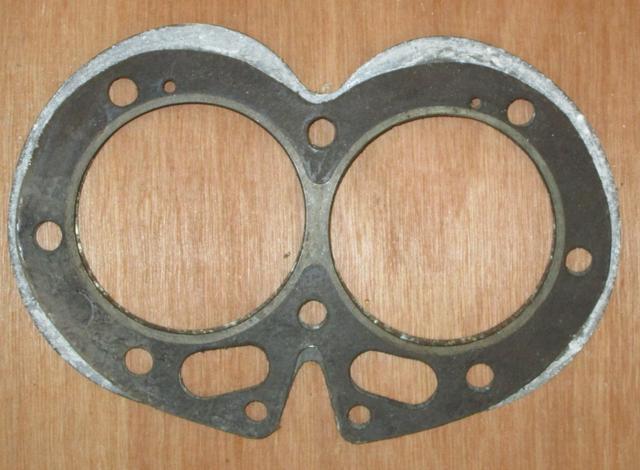
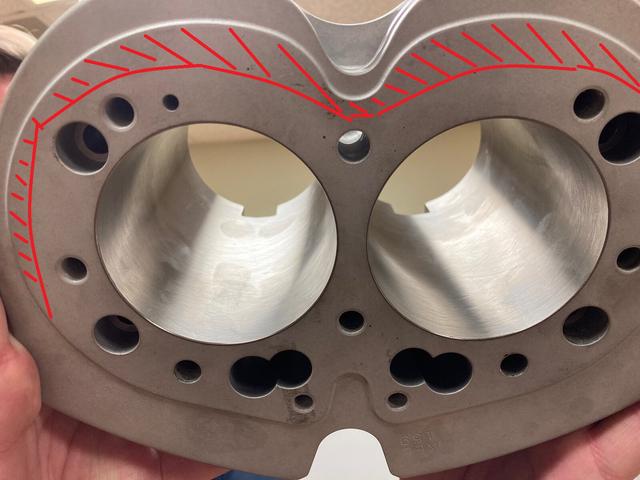
A lot of talk here about correctly torqueing and retorqueing the head bolts, but it is worth looking at the head gasket itself.
The head bolts are evenly spaced, but the surface of the head gasket is not. The 850 gasket is way too wide at the rear, which means that the clamping force on the gasket is not evenly distributed. While torqueing the head bolts, you are in fact ( trying to) bend the cylinder head. You should make the 850 gasket look more like a 750. Wider is not better.
A narrower gasket will make for a more even and higher specific pressure, better sealing, less retorque and better cooling.

New CDO Top End Break-in

New CDO Top End Break-in
the white marked and striped area are counterproductive.
 
Last edited:
Here's a comparison of sealers. Pay attention to the adhere and heat failure range.

HEAD GASKET SEALER COMPARISON


Pliobond darkens & hardens at 450 to 500F and loses integrity at 500 but still stays in place and when its cooled it remains adhered to the metal. Stays adhered at 400F over long term testing.


JB epoxy weld good to 450 and still stays in place at 500 but loses adhesion.


Permatex copper “spray a gasket” high temp – starts smoking and loses adhesion at 400 F but stays in place and is still adhered when cooled.


K&W “Copper coat” brush on gasket sealer – loses adhesion at 400 F but stays in place when cooled.


Silicone sealer resists heat up to 500F, starts to fail by 550 and loses its adhesion. Did not harden but has mediocre oil resistance. Silicone leaks oil as a head gasket sealer.


Permatex “Ultra” silicone based oil resistant gasket maker loses adhesion at approx 500F and fails. Minimal hardening. Silicone leaks oil as a head gasket sealer.


“The right stuff” by permatex should have worked but failed in a Norton as a head gasket sealer.


Hylomar AF stays gooey – non-hardening and no adhesion but good to 500 deg. Aerograde Hylomar is semi hardening and has some adhesion (but not much) after drying and is good to about 450 but looses adhesion around 500 and has poor adhesion compared to pliobond at all temps (worse at 500 deg - loses all adhesion permanently).


Wellseal stays gooey – non hardening and has no adhesion, starts smoking at 400 and turns to water consistency at 450F


Gasgacinch Weldwood and Barge contact cements burned black & hardened before pliobond and lose their adhesion at lower temps around 400F.


Permatex motoseal 1 grey (same as popular Yamabond 4) bubbled at 400F and hardened but did not lose its adhesion. Became very brittle but was still adhered when cool.


Yamabond 5 (clear contact cement) bubbled at 400F burned black, became brittle and lost adhesion.


Permatex high tac turns to liquid, smokes and loses adhesion at about 350 F.


Silver paint gets soft and loses adhesion around 350F


Permatex formagasket 1B starts smoking & bubbles and fails at 250 – 300F.
 
Back
Top