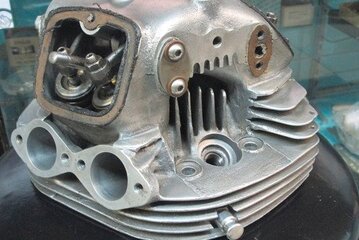
Compression Release

Joined
Jan 2, 2013
Messages
4,255
Country flag
Has anyone tried fitting a compression release to an Atlas or hybrid to ease kickover?

Any suggestions on how to....?

Slick
 
Chainsaw decompression unit screwed into side of head, make sure the final hole into the combustion chamber is smaller than the head on the end of the decompressor. The heads come off and with a smaller hole to go though can't get into the combustion chamber and bounce around.

Compression Release


You push the black knob in to open the valve prior to kicking, when the engine fires the combustion pressure forces the valve shut restoring full compression.

Someone elses version installed. From this thread


Compression Release
 
The compression release on both of my stihl .090's is not automatic closing one like the one pictured above. Mine are spring loaded, and located so you "thumb" it when you hold the saw's handle bar, while you pull the start rope with the other hand. It's on a single piston 2 stroke, so you get more inertia built up from a few compression free cycles before you release the button. It takes a lot of practice to get the timing down. In the case of the .090's I don't think a human being could start that engine without the compression release. Maybe a gorilla could start it, but not a man, so it does actually work on a 2 stroke single.

***When I've milled lumber in the past there's always been onlookers and rookies who were on the scene. Once a friend gave me his muscle boy employee to help mill a log he had. I asked muscle boy to start an engine for me. The engine ripped the handle out of his hand every time, and it hurts a lot. It usually takes a week for the person's hand to feel normal again after that. He couldn't start it, even after I showed him the technique.

I don't see why a pair of automatic compression releases wouldn't work for a norton, but looking at Constant's modification from the linked thread and his comment that it didn't help much, I would have to believe him because his opinion based on experience.

Also, not every norton is easy to kick over. Mine is a beast to kick over. Again, nobody could do it sitting on the seat, and nobody could do it with their hand... No chance jack... zero.
 
Thanks guys. I followed the link given by kommando, and it fully satisfies my inquiry.

No further replies are necessary.

Slick
 
Slick,
I can read, no further replies necessary, but some years back I spoke with Ol' T. C. Christenson, looking to have some compression releases installed. He had it listed as a service on his website, which looks like it's no longer in existence.

He comes in from the side, 3rd and 4th fins down. Mounted to the rear of the spark plug. The hole to the compression chamber locates between the spark plug and the rear mounting bolts, #4 and #5 in the torque tightening sequence.

I saved a pic on my PC, if you want one PM me with your email.
 
Slick,
I can read, no further replies necessary, but some years back I spoke with Ol' T. C. Christenson, looking to have some compression releases installed. He had it listed as a service on his website, which looks like it's no longer in existence.

He comes in from the side, 3rd and 4th fins down. Mounted to the rear of the spark plug. The hole to the compression chamber locates between the spark plug and the rear mounting bolts, #4 and #5 in the torque tightening sequence.

I saved a pic on my PC, if you want one PM me with your email.
I would like to see that!
 
I knew TC ans was going to have that work done but the machinist that did the job for TC passed away! Now i do not know where to go. Can you post the photo?
 
"The engine ripped the handle out of his hand every time, and it hurts a lot. It usually takes a week for the person's hand to feel normal again after that."

That's no shit there...
The old snowmobiles had a small t-handle, hooked to a 399cc one lunger. STING your effin paws!
The answer was to grab it between thumb & palm, with BOTH mitten clad hands.
IMG_9342.jpeg
 
You are not crazy. I've installed compression releases on two heads and my own 850 is sitting on the mill ready and waiting. I placed it very similar to the first picture, next to the spark plug. It was on a 750 and it definitely made it easier to kick. My usual method of starting is to kick it over 3-4 times with the key off. With the compression release these are "free" kicks...no resistance. The last one with the key on requires maybe half the usual effort. Unfortunately the owner didn't use the Atlas at all summer so I don't have any feedback. He was happy with the result.
I am fitting an 850 motor to my own Atlas and I guarantee it will be used several times a week. At that point I can make statements good or bad. If I'm very happy with it I'll offer it as a service. One good idea mentioned here is the hole entering the head be smaller than the head of the compression release rod. These CR valves are made by Kibblewhite and have been used on Harleys for years. About $45 for the pair.
 
You are not crazy. I've installed compression releases on two heads and my own 850 is sitting on the mill ready and waiting. I placed it very similar to the first picture, next to the spark plug. It was on a 750 and it definitely made it easier to kick. My usual method of starting is to kick it over 3-4 times with the key off. With the compression release these are "free" kicks...no resistance. The last one with the key on requires maybe half the usual effort. Unfortunately the owner didn't use the Atlas at all summer so I don't have any feedback. He was happy with the result.
I am fitting an 850 motor to my own Atlas and I guarantee it will be used several times a week. At that point I can make statements good or bad. If I'm very happy with it I'll offer it as a service. One good idea mentioned here is the hole entering the head be smaller than the head of the compression release rod. These CR valves are made by Kibblewhite and have been used on Harleys for years. About $45 for the pair.
Can you show us any pics from the combustion chamber side ?
 
On my Velocette, the valve lifter is fitted to the pivoting cam follower below the exhaust pushrod. Operated by a cable lever on handlebar...not just for getting the big 500cc single past TDC for the mighty kick, but also essential fro stopping the magneto fired engine :^)

Could a lifter be fit the to rocker arm on a Commando, attached through the rocker box cover instead of knocking holes in the cylinder head?
 
On my Velocette, the valve lifter is fitted to the pivoting cam follower below the exhaust pushrod. Operated by a cable lever on handlebar...not just for getting the big 500cc single past TDC for the mighty kick, but also essential fro stopping the magneto fired engine :^)

Could a lifter be fit the to rocker arm on a Commando, attached through the rocker box cover instead of knocking holes in the cylinder head?
It’s been done. See post #27 here. No useful details though…

 
In life, many things have to do with mindset. A well tuned motor should start first kick every time. When you know the motor will start, you do not bounce a piston off TDC. Even motors which are on 13 to 1 compression can be kick-started. However a badly tuned motor will never start. I am always careful when setting the idle, and always start the motor with the throttle closed. When it is cold, I open the enricher, and still keep the throttle closed. The motor usually starts on idle. I do not give it a big guts-full of mixture, until it is really warmed-up.
 
On my Velocette, the valve lifter is fitted to the pivoting cam follower below the exhaust pushrod. Operated by a cable lever on handlebar...not just for getting the big 500cc single past TDC for the mighty kick, but also essential fro stopping the magneto fired engine :^)

Could a lifter be fit the to rocker arm on a Commando, attached through the rocker box cover instead of knocking holes in the cylinder head?
I think this is different, but @seattle##gs will correct me if I'm wrong. On a BSA B50MX it's like you say, but the point is to get just past TDC, turn off the compression release so a strong kick makes the power (ET Ignition) and have the engine spinning enough to fire on the next time it comes to the firing point. They will not start with the compression release engaged in my experience.

I'm guessing that this is to bleed enough compression off to make starting easier. Releasing the pressure on one cylinder is not much of a help. In other words , to lower the compression ratio a little.
 
I think the issue with this idea on a twin is there isn't a lot of crank rotation btwn compression strokes...I notice a big difference btwn velo and commando trying to get over TDC...velo its relatively easy to get just past, ready for the big kick, but in commando, you got a touch to far and your's right on the other cylinders compression stroke. So even with a valve lifter on each cylinder...you will still be hard pressed to get right were you need to be for a good kick.
It may have advantages with the anemic stock electric leg....hold the lifter open as you fire up the leg....the release lifter once engine is rotating. This is the recommended way to fire a velo fitted with an aftermarket leg...otherwise you risk blowing up the gears or sprags.
 
I think the issue with this idea on a twin is there isn't a lot of crank rotation btwn compression strokes...I notice a big difference btwn velo and commando trying to get over TDC...velo its relatively easy to get just past, ready for the big kick, but in commando, you got a touch to far and your's right on the other cylinders compression stroke. So even with a valve lifter on each cylinder...you will still be hard pressed to get right were you need to be for a good kick.
It may have advantages with the anemic stock electric leg....hold the lifter open as you fire up the leg....the release lifter once engine is rotating. This is the recommended way to fire a velo fitted with an aftermarket leg...otherwise you risk blowing up the gears or sprags.
No experience with Velo. A BSA B50, especially B50MX is hard to get past TDC. It was even hard when I was young and strong but weaker relatives could not do it.

On a twin, beside what you say, many electronic ignitions first fire on the second firing stroke so the first valve being open would probably hurt nothing. Tri-Spark fires at the first opportunity so that might be better but then one valve would be open with the engine firing - seems bad to me. Also, I would be VERY careful on a Norton holding a valve open and turning the engine - hold it open too far and the pushrod could come out of place - I don't know how much is too much.
 
Back
Top